Binance Incident (October 2026)
Summary#
On 29 October 2026, attackers drained ~$6.34B (~$2.85B had been frozen or intercepted) across 10 blockchains. FBI1 later attributed the attack to North Korea’s TraderTraitor activity.
According to the Binance, a campaign involving fake recruitment interviews, compromised employee computers, and stolen deployment credentials gave the attackers unauthorized access to its internal wallet signing service 2
Unauthorized outflows occurred between 20:05 and 23:56 UTC.
The table shows the summary of drained assets.
| Time | Chain | Assets stolen (USD value) | Cause | Source |
|---|---|---|---|---|
| 20:05–20:09 | XRP | 233.46M XRP (~$296.5M) | Signed withdrawals | TX |
| 20:10–20:33 | Solana | 970,522 SOL (~$96.1M) | Signed withdrawals | TX |
| 20:16 | Base | 4.736M VIRTUAL (~$2.80M) | Signed withdrawal | TX |
| 20:18 | Optimism | 44.23M OP (~$4.80M) | Signed withdrawal | TX |
| 20:20 | Bitcoin | 18,270.2 BTC (~$1.47B) | Signed withdrawals | TX |
| 20:21 | TRON | 46.38M TRX (~$14.77M) | Signed withdrawal | TX |
| 20:22 | TRON | 612.73M USDT (~$612.73M) | Signed withdrawal | TX |
| 20:24 | Ethereum | 167,464 ETH (~$387.17M); 1.615B USDT (~$1.615B); other tokens (~$527.42M combined) | EIP-7702 sweep | TX |
| 20:24 | Ethereum | 55.74M USDT (~$55.74M); eight other asset transfers (~$116.77M estimated) | Signed withdrawals, Binance 16 | TX |
| 20:30–20:34 | Arbitrum | 74.56M ARB (~$12.32M); 8,426 ETH (~$19.48M) | Signed withdrawals | ARB TX |
| 20:33–23:04 | Avalanche | AVAX (~$19.6M); USDT (~$8.41M) | Signed withdrawals | TX |
| 20:41 | Ethereum | 780M USDC (~$779.62M) | EIP-7702 execute | TX |
| 20:59 | Ethereum | 43M USDC (~$42.98M) | EIP-7702 execute | TX |
| 21:04 | Ethereum | 1,699.9 ETH (~$3.84M); 3.92M USDT (~$3.92M) | EIP-7702 follow-up sweep | TX |
| 21:44 | Ethereum | 369.8 ETH (~$835K); 200.4M USDT (~$200.4M) | EIP-7702 follow-up sweep | TX |
| 22:39 | Ethereum | 128.49 ETH (~$289K); additional ERC-20s (unpriced) | EIP-7702 follow-up sweep | TX |
| 23:05 | Polygon | 46.63M POL (~$3.81M); 6.19M USDT0 (~$6.19M) | Signed withdrawals | POL TX |
| 23:56 | Ethereum | 2,961.91 ETH (~$6.66M) | EIP-7702 follow-up sweep | TX |
Binance's initial report 2 disclosed how the attacker gained access to its signing infrastructure, where the attacker likely signed transfers directly on networks such as XRP and Solana. So, this article focuses on how the attacker used EIP-7702 to drain the initial ~$2.53B (of ~$6.34B).
For an introduction to EIP-7702, see the appendix.
1. Preparing the Attack#
| Entity | Address |
|---|---|
| Attacker operator EOA | 0x7C8601d4645b93cea45F71e118A729332e6B5CA0 |
| Malicious sweeper contract | 0x63e8…6fAe |
| Victim: Binance 14 | 0x28C6c06298d514Db089934071355E5743bf21d60 |
| Attacker collection wallet | 0x5227f603C1eE34CE3C06eFe6477003BDfCCB2f8c |
1.1 Deploying the Malicious Sweeper#
At 15:59:11 UTC, the attacker submitted an Ethereum contract-creation transaction. Ethereum stored 1,674 bytes of runtime bytecode at the sweeper contract's address.
Contract: https://etherscan.io/address/0x63e842B054Bd624a465454D533C33F573e9c6fAe
- There are two primary functions
sweepandexecute.sweep: transfers ETH and the balances of explicitly listed ERC-20 tokens to a recipientexecute: makes arbitrary calls to a specified address, using supplied calldata and an optional ETH value.
- Only the hardcoded operator EOA can invoke
sweepandexecute.
// Conceptual reconstruction from the contract above

contract AttackerSweeper {
    address constant OPERATOR = 0x7C8601d4645b93cea45F71e118A729332e6B5CA0;

    function sweep(
        address recipient,
        address[] calldata tokens
    ) external {
        require(msg.sender == OPERATOR);

        for (uint256 i = 0; i < tokens.length; i++) {
            if (tokens[i] == address(0)) {
                // Transfer available ETH to recipient
            } else {
                // Read this account's ERC-20 balance
                // Transfer balance to recipient
            }
        }
    }

    function execute(
        address target,
        uint256 value,
        bytes calldata data
    ) external {
        require(msg.sender == OPERATOR);

        // Call another contract using this account's authority
    }
}
1.2 Gaining Access to Binance’s Signing Service#
Binance's initial report describes the following sequence.2
2026-06:
- Engineer A from Wallet DevOps downloaded a tampered Homebrew installer when trying to install an AI coding tool.
- Binance security team detected the anomaly, replaced his computer, and rotated the related credentials.
- However, the attacker was able to know A's role and his colleagues on the wallet infrastructure team.
2026-09:
- A fake Project Director contacted Engineer B through a legitimate job-hunting platform (his profile mentioned Binance).
- The recruiter arranged two interviews:
- A live video call with a fake HR representative, who shared a social media account with personal photos and videos to build trust, which may lower B's guard.
- A second interview through a popular social chat app with the supposed CEO of a fictitious company. B was told to download an assignment repository. He did it on his work computer. Its malicious code ran during setup.
- The malware used obfuscation, making detection and investigation harder. Binance described it as "0-day malware" and said endpoint security tools did not detect it at the time.
2026-10-20:
- From B's compromised work computer, the attacker used an internal AI tool to compromise the computers of Wallet DevOps Engineer A and Wallet Software Engineer C. The attacker found a token on A's computer that allowed container deployment.
2026-10-29, 17:15–19:56:
- The attacker logged into C's computer, used credentials stolen from A to deploy a container, and ran a malicious script to launch the attack.
Unable to render diagram.
2. Installing the Malicious EIP-7702 Delegation#
http://etherscan.io/tx/0xad99264d5532ae0dd04b2004eebda05f25657e70dacb764f7ac8d4ccd051298b
| Field | Recorded value |
|---|---|
| Type | 0x04 |
| Sender | Attacker EOA 0x7C8601d4…5CA0 |
| Destination | Binance 14 0x28C6c062…1d60 |
| Authorization list | 50 signed tuples |
| Accepted Binance nonce | 18,914,809 |
What is type-4 transaction?
| Transaction type | Purpose |
|---|---|
0x00 | Legacy Ethereum transaction |
0x02 | EIP-1559 transaction, with priority and maximum gas fees |
0x03 | EIP-4844 blob transaction |
0x04 | EIP-7702 transaction, capable of carrying signed code-delegation authorizations |
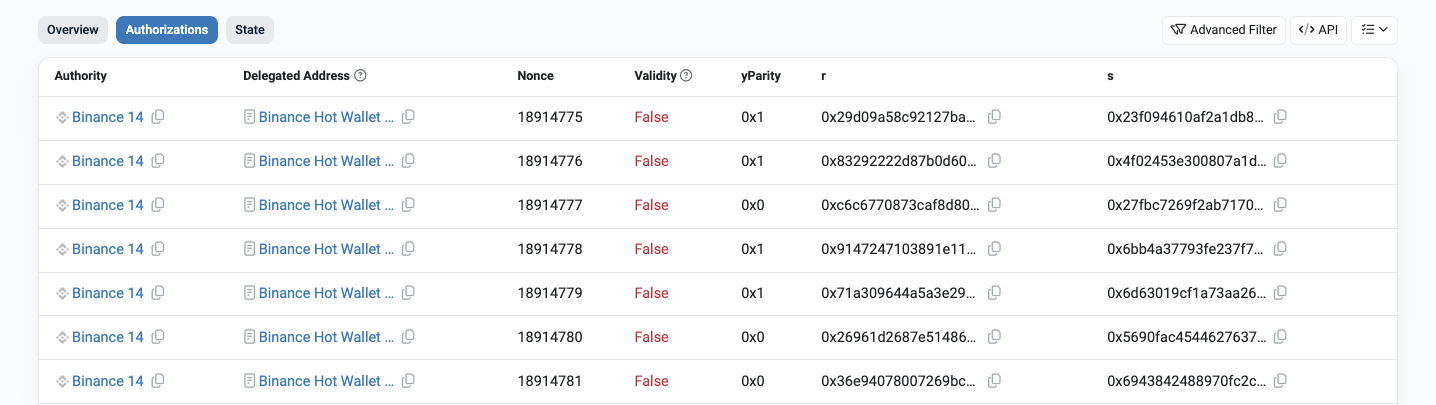
This transaction establishes that 50 different ECDSA signatures were produced using Binance 14's signing authority. Each signature authorized the same sweeper implementation, but used a different nonce.
50 consecutive authorizations increased the chance that one would match the wallet's nonce at execution time, since Binance 14 was a high-volume hot wallet and its nonce changed constantly as it signed withdrawals. May refer ChainWard's nonce analysis3.
50 authorizations in the transaction:
...
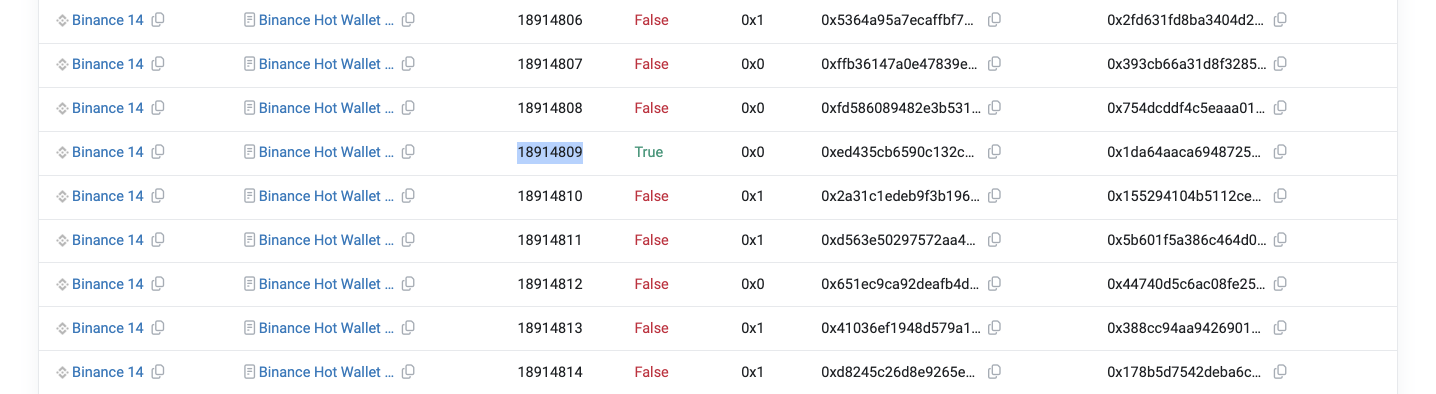
At this point, the attacker had already compromised Binance 14 wallet. The wallets delegated execution to the attacker-controlled sweeper contract (0x63e8…6fAe), allowing the attacker to run its code in Binance 14’s account context.
When Ethereum executes any transaction to Binance 14, it recognizes the special code format, follows its address pointer, and loads the runtime bytecode stored at the sweeper contract's address.
Unable to render diagram.
3. Draining Binance 14 Through the Delegated Code#
Unable to render diagram.
This focuses only on the sweeper contract's sweep() function. It omits execute(), which was used for the later USDC transfers.
https://etherscan.io/tx/0x53bd38b816c23e74134786c29a8c18d792777998a3b9326047b583100e88e2f3
| Field | Recorded value |
|---|---|
| Transaction type | 0x02 — ordinary EIP-1559 |
| Sender | Attacker 0x7C8601d4…5CA0 |
| Destination | Binance 14 0x28C6c062…1d60 |
| Function selector | 0x8a179be4 |
| Native ETH moved | 167,464.2479 ETH |
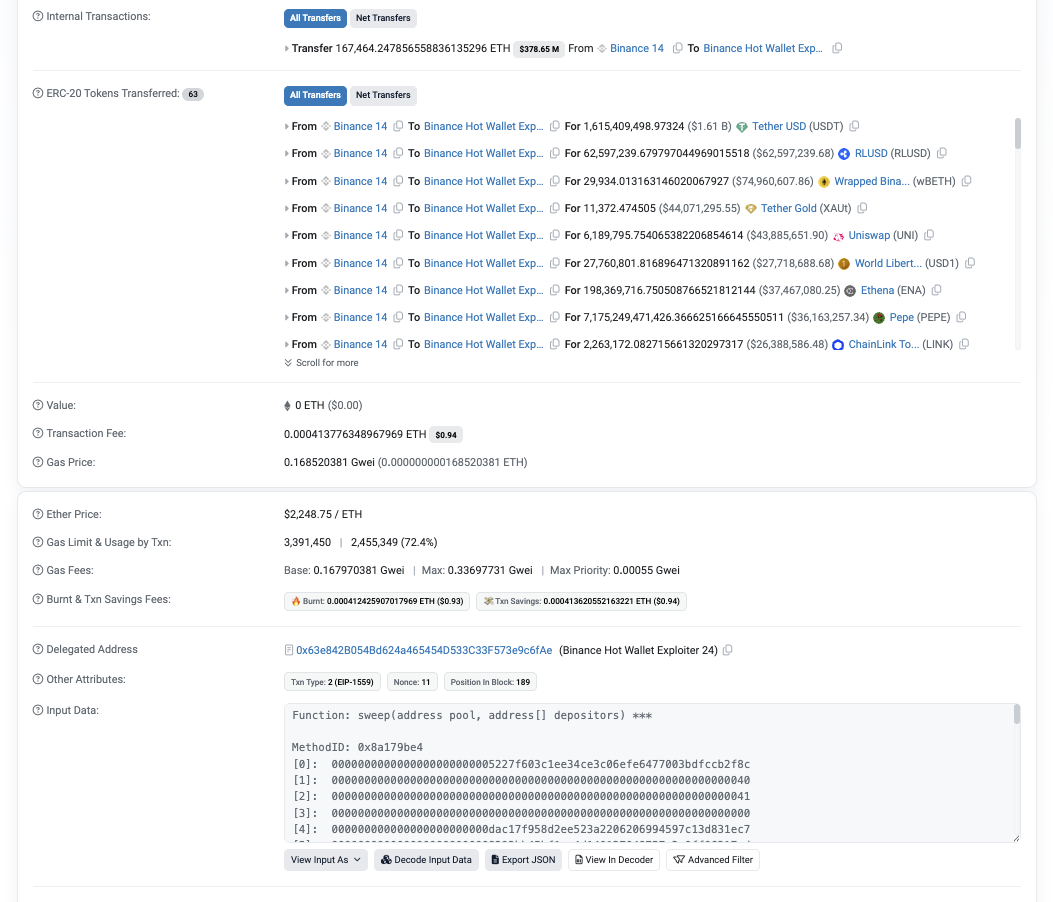
The transaction input:
Function: sweep(address pool, address[] depositors)

MethodID: 0x8a179be4
[0]:  0000000000000000000000005227f603c1ee34ce3c06efe6477003bdfccb2f8c
[1]:  0000000000000000000000000000000000000000000000000000000000000040
[2]:  0000000000000000000000000000000000000000000000000000000000000041
[3]:  0000000000000000000000000000000000000000000000000000000000000000    // ETH
[4]:  000000000000000000000000dac17f958d2ee523a2206206994597c13d831ec7    // USDT
[5]:  0000000000000000000000008292bb45bf1ee4d140127049757c2e0ff06317ed    // RLUSD
[6]:  000000000000000000000000a2e3356610840701bdf5611a53974510ae27e2e1    // WBETH
[7]:  00000000000000000000000068749665ff8d2d112fa859aa293f07a622782f38    // XAUT
[8]:  0000000000000000000000001f9840a85d5af5bf1d1762f925bdaddc4201f984    // UNI
...
[65]: 0000000000000000000000004c1746a800d224393fe2470c70a35717ed4ea5f1    // PLUME
[66]: 000000000000000000000000dc035d45d973e3ec169d2276ddab16f1e407384f    // USDS
[67]: 00000000000000000000000031c8eacbffdd875c74b94b077895bd78cf1e64a3    // RAD
The transaction specifies 65 assets in its input and invokes the code the attacker deployed during the preparation phase. This enabled the attacker to drain approximately $2.53B in the initial sweep using EIP-7702.
As part of its incident response, Binance submitted a new EIP-7702 transaction carrying an authorization to the zero address, clearing the delegation.
Revocation transaction: October 30, 00:10:35 UTC https://etherscan.io/tx/0xafbf94c92a8d749988411669fa14d4f8866d9b4420b4ebd299f28e958dac7209
The delegation had remained active for 3 hours, 49 minutes.
Takeaways and Open Questions#
Because the hot wallet used Multi-Party Computation (MPC), there was no single private key that could be used to immediately revoke the malicious EIP-7702 authorizations. The team therefore developed and executed a specialized procedure to revoke these authorizations, which required additional time. These challenges extended the time required to fully contain the unauthorized asset movements. We are reviewing the incident response process, signing policy coverage, hot wallet controls and identifying opportunities to further strengthen our ability to respond rapidly to threats in the future.
Binance reported 2 that MPC complicated revocation and required a specialized procedure. We need to design and test emergency revocation alongside normal wallet operations considering this tradeoff.
The malware employed sophisticated obfuscation and evasion techniques, including replacing a legitimate development tool component with a malicious version to execute commands and establish communication with an attacker-controlled external server. The 0-day malware was not detected by the endpoint security protection tools at the time. The attacker also took steps to conceal the malicious activity and remove traces of the compromise, making detection and subsequent investigation more challenging.
Compromised work computers gave the attacker a path to deployment credentials and wallet signing operations.2 What the attacker wants is, at the end of the day, the credentials stored in the work computers.
- Work computers only for approved work activities
- Hardware security keys (e.g., U2F and FIDO2) for deployment
We have also implemented tighter device controls, enhanced wallet-service risk controls and expanded AI-based behavioural anomaly detection.
Binance also reported 2 that it subsequently expanded AI-based behavioral anomaly detection.2
- Further practice and study with AI-based behavioral anomaly detection
Appendix: How EIP-7702 Works#
This appendix introduces EIP-7702 45.
Motivations and Problems#
Alice has a Metamask wallet with:
- 100 USDC
- 0 ETH
Alice now wants to swap her 100 USDC for ETH on a DEX.
The Traditional Flow#
Before EIP-7702 was introduced (before Ethereum's May 2025 Pectra upgrade), Alice would need to:
- Approve: Sign an Ethereum transaction that allows the DEX's contract to spend her USDC.
- Swap: Sign a second transaction that tells the DEX to exchange her USDC for ETH. Both transactions consume gas, which is paid in ETH. (Alice has 0 ETH)
There were 2 limitations in the traditional EOA.
- No transaction batching: It cannot execute a sequence transaction like "approve USDC, then swap it," as one atomic operation.
- No gas sponsorship: Standard EOA transactions require the sender (Alice) to pay gas in ETH.
EIP-7702 as the Solution:#
Suppose a trusted wallet developer (the DEX developers in the above example) deploys a smart-contract implementation at 0xSMART.
Its code supports:
- Executing several operations together.
- Checking Alice's authorization for those operations.
- Working with a service that sponsors transaction gas.
Alice can sign an EIP-7702 authorization to delegate her account’s execution to that implementation.
Conceptually, her account changes from: Before EIP-7702:
Alice.address = 0xAlice
Alice.code = 0x (No executable code)
After EIP-7702:
Alice.address = 0xAlice
Alice.code = 0xef0100 + 0xSMART
0xef0100 is a delegation prefix.
The code works like a pointer to existing contract code, not a copy of the entire program due to storage constraints.
When someone calls Alice's account, Ethereum follows that pointer and executes the implementation's instructions in Alice's account context.
Alice's swap with EIP-7702: With an appropriately designed wallet implementation and gas sponsor, the flow would look like this:
- Alice authorizes the wallet implementation. She signs an EIP-7702 delegation to
0xSMART. This selects the code her wallet will use. - Alice approves a specific action. The wallet implementation verifies her authorization to perform a batch: approve the DEX to spend 100 USDC, then execute the swap.
- A sponsor submits the transaction. The sponsor pays the Ethereum gas in ETH, so Alice does not need ETH.
- The wallet executes the batch. The approve and swap steps run together atomically.
- Alice receives ETH at the same address.
References#
Footnotes#
-
Federal Bureau of Investigation. North Korea Responsible for $6 Billion+ Binance Attack. 31 October 2026. ↩
-
Binance. 29 October 2026 Binance Security Incident: Initial Findings and Response Update. Binance Blog, 3 November 2026. ↩ ↩2 ↩3 ↩4 ↩5 ↩6 ↩7
-
ChainWard. Binance's Hot Wallet Was Signed Over to the Attacker for 3 Hours, 49 Minutes and 36 Seconds. 30 October 2026. ↩
-
Vitalik Buterin, Sam Wilson, Ansgar Dietrichs, and lightclient. EIP-7702: Set Code for EOAs. Ethereum Improvement Proposals, created 7 May 2024. ↩
-
ethereum.org. Pectra EIP-7702. Accessed 6 November 2026. ↩